
Morning Coffee — Friday the Thirteenth
BRCFinTech.com | March 13, 2026
by Lars Toomre, Managing Partner, Brass Rat Capital LLC ("BRC") and BRC FinTech Corporation ("BRCF")
"The only thing we have to fear is fear itself — nameless, unreasoning, unjustified terror which paralyzes needed efforts to convert retreat into advance." — President Franklin D. Roosevelt, First Inaugural Address, March 4, 1933
⚠ PRICE NOTE — Updated 4:20 AM ET, Friday March 13: All prices in this post reflect the best available data at time of writing, combining Thursday March 12 confirmed closing data with early Asian Friday session levels. Brent crude eased to approximately $99–$101 in early Friday Asian trading after Thursday's $100.46 close, following the late-Thursday U.S. Treasury announcement of a 30-day Russian oil sanctions waiver — then partially reversed. WTI early Friday ~$97. Full market close figures will be confirmed with Bloomberg, the Wall Street Journal ("WSJ"), and the Financial Times ("FT") at market open. Prices remain highly volatile and directional views in this post are structural, not intraday.
I. The Calendar and Its Ironies
Good morning. Today is Friday the 13th. The Bull Shit Detection ("BSD") algorithm does not believe in superstition. But it has a deep respect for irony.
Today marks the 40th anniversary of the Microsoft Corporation ("MSFT") initial public offering, March 13, 1986. The company priced at $21 per share on that day, raised $61 million, and debuted with a market capitalization of approximately $520 million. A single split-adjusted, dividend-reinvested share purchased at the IPO is now worth north of $28,000. In the forty years between that offering and this morning, more wealth was created per dollar of original capital than in any prior technology company in history. The lesson embedded in that number — that dominant software platforms compound in ways that defy conventional valuation — has shaped institutional equity investing ever since. The lesson that the same investors occasionally forget is that compounding requires the system to remain solvent. Today's Morning Coffee is, at its core, about solvency.
Today is the 13th anniversary of the election of Pope Francis, chosen on 13/3/13 — and now observed on a Friday. The BSD notes the numerological coincidence without assigning it analytical weight. It does note that Pope Francis was elected partly on a mandate of reform of an institution perceived as insular, resistant to accountability, and structurally resistant to transparency. Lars Toomre regards that description as applicable to several other institutions that will appear later in this post.
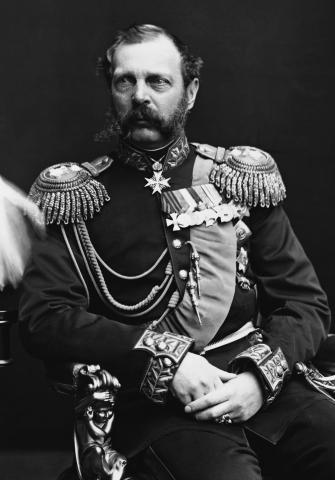
 Czar Alexander II of Russia — killed March 13, 1881 by a second bomb thrown while he attended to victims of the first. The original case study in Second-Event Risk.
Today marks the 145th anniversary of the assassination of Czar Alexander II of Russia, killed on March 13, 1881 in St. Petersburg. The revolutionary Ignacy Hryniewiecki threw the first bomb, which struck the Czar's carriage but did not immediately kill him. Alexander stepped out to attend to his wounded guards — an act of visible sovereign duty. Hryniewiecki threw the second bomb directly at the Czar's feet. The second bomb was fatal. The lesson is operational and precise: a primary event causes damage but fails decisive effect; principals expose themselves managing the first event's damage; the second event, arriving while attention is divided, achieves what the first could not. Lars Toomre has been developing the Second-Event Risk framework in these pages since Operation Epic Fury ("OEF") commenced February 28, 2026. Sections VIII and XII return to it with specific 2026 candidates.
Today is World Sleep Day, an annual global awareness event organized by the World Sleep Society. The BSD notes the metaphorical resonance with institutional risk management at this particular moment: professional investors appear to be walking through an extraordinary geopolitical and financial environment while maintaining a remarkable posture of high-quality somnambulism. The VIX at approximately 24 — in a world where the International Energy Agency ("IEA") formally declared Thursday that the Iran war is creating the biggest oil supply disruption in history — is the quantitative signature of that somnambulism. The sleepwalker will wake. The question is what they will find themselves standing next to.
II. The "Strait of America" — What the Map Has Already Told You
 The Strait of Hormuz as it has been circulating in global social media since the commencement of Operation Epic Fury. The relabeling is sardonic — but analytically precise. By deploying military power to enforce freedom of navigation in the world's most critical maritime chokepoint, the United States has implicitly assumed ownership of the consequences.
The image above has been circulating globally since February 28, 2026. It is not official cartography. It is commentary — specifically, the kind of pithy, image-based commentary that reaches audiences that no financial research report will ever touch. The BSD reads it as analytically precise.
The Strait of Hormuz — 21 miles at its narrowest point, bounded to the north by Iran and to the south by Oman and the United Arab Emirates — carries approximately 20 to 21 percent of global petroleum liquids and approximately 17 percent of global LNG trade through its shipping lanes on any given day. On March 9, 2026, Iran's newly appointed Supreme Leader Mojtaba Khamenei declared that the Strait must remain closed as "a tool to pressure the enemy." By deploying American and Israeli air power to conduct kinetic operations that have now generated a 14-day Strait closure, the United States has acquired something no nation sought to own: responsibility for the consequences of that closure.
When the Strait of Hormuz effectively becomes the "Strait of America," every downstream consequence — from $100 Brent crude to Singapore distillate shortages to European fertilizer constraints to Asian manufacturing disruptions — becomes, in the court of global public opinion, an American consequence. The BSD does not make a moral judgment about whether this attribution is fair. It observes that the attribution is occurring, that it is appearing in the language of diplomatic communiqués, and that it will shape the diplomatic options available for resolution. A resolution that appears to reward the party that closed the Strait will be structurally different, and more difficult to construct, than a resolution that appears to end a brief military operation with clearly defined objectives.
Russia understands this asymmetry. A Washington Post report from March 6, 2026 — confirmed by U.S. officials — describes Russian intelligence services providing Iranian forces with the locations of American military assets, including warships and aircraft. This is not "Putin's Hidden Hand" as speculation. It is confirmed operational intelligence sharing between Moscow and Tehran. It has two effects simultaneously: it directly increases the operational risk to U.S. forces, and it deepens the political cost to Washington of any diplomatic resolution that could be framed as capitulation to an Iranian adversary receiving Russian support.
Senator Jeanne Shaheen of New Hampshire, ranking member of the Senate Committee on Foreign Relations, wrote on Thursday: by issuing a Russian oil waiver while Russia provides Iran with targeting data for American forces, the administration is "filling the Kremlin's war coffers" while American service members are in the field. This is not political theater. It is a structural contradiction that will constrain the administration's diplomatic options for the duration of OEF. The BSD flags the Russian intelligence confirmation as a Scenario C precursor — not a probability assignment but a condition precedent that, if amplified, leads in directions that no current market model has priced.
III. The KC-135 and the Operational Math
The confirmed loss of a United States Air Force Boeing KC-135 Stratotanker over western Iraq late Thursday, with six service members aboard, is the fourth manned U.S. aircraft lost in OEF. United States Central Command ("CENTCOM") indicated the incident was not the result of hostile or friendly fire, suggesting a mid-air collision during aerial refueling operations. In the first thirteen days of OEF, approximately seven American service members have been killed in action and roughly 140 wounded.
The KC-135 Stratotanker is a Boeing 707 derivative first delivered in 1956. The Air Force operates approximately 396 KC-135 aircraft — the overwhelming majority of U.S. aerial refueling capacity. There is no full operational replacement. The KC-46 Pegasus, chronically delayed by technical deficiencies in its remote vision system, provides approximately one-third of the fuel offload per sortie compared to the KC-135. High-tempo OEF operations — combat air patrols over the Persian Gulf, strikes on Iranian defensive infrastructure, suppression of enemy air defenses ("SEAD") across a theater stretching from the Levant to the Gulf of Oman — are being supported by airframes designed before John F. Kennedy was inaugurated. The statistical probability of further non-combat attrition rises in direct proportion to sustained sortie rates.
Four aircraft in thirteen days is not yet a crisis. It is a trend line. The Goldman Sachs 21-day resolution model may already require revision for reasons beyond crude duration: the operational tempo that the model assumes is achievable only if the logistics infrastructure — tanker assets, forward positioning, maintenance cycles — holds. The KC-135 loss, superimposed on the Iranian declaration that the Strait is a permanent pressure instrument, is the War Duration Risk clock advancing on two axes simultaneously.
Iran overnight conducted what its state media described as its "most intense operation since the beginning of the war," firing advanced ballistic missiles toward Tel Aviv and Haifa. This is a significant escalation from the drone-and-missile mix of earlier operations. Ballistic missiles targeting Israel's two largest urban centers represent a capability deployment — the use of the most advanced systems in the Iranian inventory — that suggests Iranian leadership has concluded that escalation dominance, not negotiation, is the current strategy. The Goldman 51-day resolution scenario, already under stress from Khamenei's Strait policy declaration, is now stress-tested again by the overnight ballistic missile barrage. Lars Toomre does not believe the Goldman scenario survives the combination of these inputs.
IV. The Russian Oil Waiver and the Sanctions Architecture It Just Fractured
Late Thursday evening, U.S. Treasury Secretary Scott Bessent announced a 30-day license authorizing the purchase of Russian crude oil and petroleum products currently loaded on vessels as of March 12, 2026. The license is valid through midnight Washington time on April 11. Treasury Secretary Bessent characterized the measure as "narrowly tailored" and "short-term" and maintained it would not provide significant financial benefit to the Russian government.
The BSD notes several structural implications that the "narrowly tailored" framing obscures.
On magnitude: According to Fox News reporting, approximately 124 million barrels of Russian-origin oil are currently on water across 30 global locations. At current global daily consumption rates, this represents approximately five to six days of the supply lost through the Strait closure. It is a larger version of the IEA 400-million-barrel palliative — meaningful at the margin, insufficient at the structural level.
On the sanctions architecture: The European Commission President Ursula von der Leyen, after a G7 call Wednesday, stated explicitly that "now was not the time to relax sanctions against Russia." The U.S. Treasury issued the waiver approximately 36 hours later. The EU-U.S. split on Russia sanctions policy, occurring simultaneously with confirmed Russian intelligence support for Iranian forces targeting American military assets, represents the most significant fracture in the transatlantic sanctions regime since the Ukraine invasion. Markets have not priced this fracture.
On the signaling: The waiver signals that the United States will modify its sanctions architecture under economic pressure from a crisis it initiated. For every sanctioned country observing this dynamic — Iran, Russia, China, North Korea — the signal is that sustained application of economic pressure on American consumers produces sanctions relief. This is precisely the signal that a 30-day "narrowly tailored" license was supposed to avoid sending. The BSD regards the gap between the Treasury's framing and the observable behavioral signal as one of the more significant analytical blind spots in the current policy environment.
On the market impact: Oil prices eased in early Asian trading Friday following the waiver announcement, with Brent falling below $100 briefly before recovering. The early Friday range suggests Brent approximately $99 to $101, WTI approximately $96 to $98. The partial recovery from the waiver-driven dip confirms what the IEA already stated on Thursday: this is the biggest oil supply disruption in history. Five to six days of replacement supply, arriving from stranded Russian tankers, does not resolve the physical market architecture that is driving OVX to 108.
The BSD's classification of the Russian waiver: it is a Palliative. A specifically defined concept in the Wilt Knowledge Garden ("WKG"): an intervention that relieves observable symptoms without addressing the structural cause. The structural cause is a closed strait. No Russian oil tanker currently at sea resolves a closed strait.
V. Private Credit and the Circular Lending Architecture
On Wednesday, March 11, 2026, Morgan Stanley announced caps on withdrawals from its private credit fund vehicles. This is the most significant private credit event since Blue Owl Capital's OBDC II fund suspended redemptions on February 18, 2026 — following a 200 percent surge in withdrawal requests — and since Blackstone's BCRED faced $3.8 billion in redemption requests requiring senior leaders to personally contribute approximately $150 million to cover.
Morgan Stanley is a Global Systemically Important Bank ("GSIB"). When a GSIB moves to cap redemptions in a private credit vehicle, the circle of systemic concern expands from the alternative asset management complex into the regulated banking system.
The structural parallel the mainstream press has been reluctant to name: the 2006-07 structured credit apparatus allowed originators to pool B-rated mortgages, tranche them, and present the senior slice as AAA based on correlation assumptions that proved fictitious under stress. In 2026, the private credit apparatus has allowed leveraged buyout lenders to hold covenant-lite loans at par on internal marks, present the senior facilities as investment-grade equivalent, and avoid secondary market clearing until redemption pressure forces it. Secondary market clearing is now occurring. The internal marks, in several documented cases, are materially higher than actual clearing prices.
Blue Owl Capital's $1.4 billion loan sale — 128 companies, 27 industries, 13 percent software — was accompanied by a public statement emphasizing "no hidden backstops." The denial was volunteered. The market had not asked. Volunteered denials of unasked questions are among the BSD's more reliable behavioral signals.
JPMorgan's limitation on new lending against private credit collateral is equally diagnostic. A bank limiting collateralized lending against private credit instruments is stating that its internal models no longer produce confident answers to the question: what is this collateral worth in forced liquidation? That uncertainty is not a private credit fund problem. It is a banking system problem. The private credit instruments are collateral for bank lending, which is collateral for further lending, which extends across the system in ways no single institution can map in real time.
Goldman Sachs's FICC co-head was reported this week as privately characterizing the Strait of Hormuz situation as "a distraction from private credit." The BSD does not read this as dismissal of the Hormuz risk. It reads it as an assessment that the private credit risk is larger than the Hormuz risk — or, more precisely, that the Hormuz risk is the accelerant that will force the private credit reckoning onto a timeline that otherwise might have extended several more quarters.
The GSIB disclosure window that Lars Toomre has been tracking: based on historical precedent (Bear Stearns recognized internal severity of its structured credit exposure approximately three to four months before its public event), the analogous window for private credit GSIB disclosures runs May through October 2026. The energy shock compresses that window. The BSD has it marked.
VI. China's Clock
China imports approximately 11 million barrels per day of crude oil, of which 40 to 45 percent comes from Persian Gulf producers. China's strategic petroleum reserve ("SPR") provides approximately 90 days of net import coverage.
The clock started on February 28, 2026. It is now Day 13. The arithmetic produces a hard ceiling of approximately late May 2026 — call it 60 to 90 days from now — at which point reserve drawdown transitions from financial management to production constraint. Chinese industrial output, petrochemical production, and transportation fuel begin experiencing genuine physical shortfalls, not merely price increases.
China is not passive. Overland crude sourcing from Russia via the Power of Siberia pipeline complex is being accelerated. Emergency swap arrangements with Kazakhstan are under negotiation. Back-channel communications to all parties maintain pressure for some resolution of Persian Gulf crude flow. But China cannot pipeline its way out of a 40 percent import shortfall within any timeframe relevant to the current crisis. The overland infrastructure exists for approximately 30 percent of requirements, not 100 percent.
The geopolitical implication: there is an expiration date structurally determined by Chinese reserves arithmetic, not by anyone's diplomatic preferences. Between late April and late May 2026, China will face a binary choice — accept economic production constraints with domestic political consequences, or take action in the option space that the market has assigned approximately zero probability. The BSD does not specify what that action might be. It notes that "zero probability" assigned to a structurally inevitable constraint boundary is the definition of a mispricing.
VII. Bond Vigilantes, the Trap Door, and Gold's Correct Diagnosis
The Trap Door
The U.S. 10-year Treasury note is trading at approximately 4.21 to 4.22 percent in bear steepening mode — market-driven, not Fed-driven. The Federal Reserve has held rates at 3.50 to 3.75 percent; per CME Group FedWatch, 95.6 percent of market participants expect no change at the March 18 meeting.
The 4.25 to 4.30 percent range on the 10-year is a structural trap door. If Brent crude remains at or above $100 for the next 60 to 90 days — and the structural factors in Sections II through VI suggest this is at minimum a 40 to 50 percent probability — the year-over-year energy contribution to the Consumer Price Index ("CPI") flips inflationary by May or June 2026. February 2026 CPI printed at 2.4 percent on Thursday — confirming the pre-shock cooling trend. That cooling trend is already over in energy.
The Federal Reserve's specific problem in a supply-shock scenario: raising rates into external-event inflation is economically counterproductive (it does not address the supply constraint) and politically radioactive. The Fed will likely hold. The bond market can price in inflation expectations independently of Fed action. Bear steepening represents exactly that: a rising term premium without Fed validation. The CBOE Move Index ("MOVE") at approximately 76, diverging from the CBOE Crude Oil Volatility Index ("OVX") at approximately 108, means the bond market has not yet fully repriced toward the OVX scenario. When MOVE and OVX converge from below, MOVE will be the moving component. The trap door opens at 4.25 to 4.30 percent.
Trump's demand Friday that the Federal Reserve cut rates — occurring simultaneously with the Iran war driving OVX to 108 — is the most direct illustration of the policy incoherence described above. The Fed will not cut. The market knows the Fed will not cut. The administration knows the market knows. This is not a policy signal. It is a political positioning statement for the November midterm election cycle. The BSD categorizes it accordingly and moves on.
Gold's Correct Diagnosis
Gold closed at $5,110.50 per troy ounce on Thursday, down $64.73 (-1.25 percent) on the session. Silver closed at $85.12 per troy ounce, down $0.63 (-0.73 percent). Gold/silver ratio: 59.6:1.
Gold is declining while oil surges. Popular narrative fails here. Gold rises in response to monetary anxiety — currency debasement, central bank credibility risk, systemic financial collapse risk. It does not reliably rise in physical supply crises. Gold is not stupid. It is correctly diagnosing that the current crisis is a physical supply crisis, not a monetary crisis. The diagnostic implication: energy-intensive businesses, physical commodity producers, and infrastructure owners insulated from energy cost pass-through are the correct hedges — not gold, and not long duration Treasuries.
Silver at $85.12 per ounce tells a more complex story. The COMEX structural stress — registered inventory depletion, First Notice Day delivery dynamics, Bank Participation Report anomalies — that the GROUP-17 analysis has been tracking remains unresolved. Silver's dual monetary and industrial demand profile means it behaves differently from gold in a physical supply shock: the industrial demand component (solar photovoltaic, electronics, medical devices) is genuinely constrained by the energy cost increase rippling through manufacturing supply chains. The gold-silver ratio tightening to 59.6:1 is worth watching as a COMEX structural signal.
VIII. The Singapore Squeeze, the Fertilizer Fuse, and the Helium Cascade
Singapore Squeeze
Singapore Jet A-1 aviation turbine fuel is trading above $231 per barrel. The European jet-diesel regrade — the spread between Jet A-1 and diesel — has widened to approximately $48 per barrel, an all-time record. Lufthansa, IAG, and Ryanair have all issued profit warnings linked to fuel volatility.
The more consequential development: China has canceled agreed gasoline and diesel export cargoes to Asian markets. This is no longer a supply disruption. It is demand-side hoarding by the world's largest crude importer. When China cancels export commitments to secure domestic product, the shortage has moved from regional to global.
The Fertilizer Fuse: 19 Days Remaining
The causal chain tracked in this column since February 28 runs: Strait of Hormuz closure → Qatari LNG export suspension → European gas availability constraint → Haber-Bosch ammonia synthesis restriction → Urea production shortfall → Northern Hemisphere spring planting window at risk.
Qatar's North Field reservoir supplies approximately 35 percent of global LNG trade. The North Field's unusual helium concentration is also what makes Qatar the world's lowest-cost helium producer — a connection developed below. Granular urea prices on the Argus Black Sea index are approaching all-time highs. The spring planting window for the United States, Canada, and Europe closes approximately April 1 — 19 days from today. Insufficient nitrogen application in the 2026 planting cycle translates directly to reduced yields for the 2026 harvest and structurally elevated food prices in 2027. Soft commodity forward markets have already begun to move. Consumer price surveys have not yet incorporated this signal.
The Helium Cascade: The Risk Nobody Is Pricing
Qatar is responsible for approximately 32 percent of global helium supply as a byproduct of its North Field LNG production. The suspension of Qatari LNG exports simultaneously suspends helium production and export. This is an unintended but structurally inevitable consequence of the Strait closure.
Helium's criticality is specific. Liquid helium — boiling point 4.2 Kelvin — is the only practical coolant for superconducting systems requiring no temperature variation. In semiconductor manufacturing, helium performs three critical functions in Extreme Ultraviolet ("EUV") lithography systems manufactured exclusively by ASML Holding N.V. ("ASML"): plasma source cooling, tin droplet dynamics management in the laser-plasma interaction zone, and reticle/optical path purging. EUV lithography is the only commercially available technology for producing semiconductor process nodes at 7 nanometers and below.
ASML's three primary EUV customers — Taiwan Semiconductor Manufacturing Company Limited ("TSMC"), Samsung Electronics Co., Ltd. ("Samsung"), and Intel Foundry Services — collectively depend on helium at every EUV-equipped fabrication facility. A sustained 30 percent reduction in global helium supply, which is plausible given that the Qatari LNG suspension is now 14 days old, does not immediately halt chip production. It produces, within approximately 60 to 90 days as inventory buffers are consumed, an allocation decision: which fab, producing which chips, receives the available helium?
That allocation decision will fall to Air Products and Chemicals Inc. ("Air Products"), Linde PLC ("Linde"), and Matheson (subsidiary of Nippon Sanso Holdings) — the three primary industrial gas distributors. Their allocation books will be the canary. The cascade: helium constraint → EUV throughput reduction → advanced chip output constraint → TSMC/Samsung H2 2026 allocation decisions → Magnificent Seven ("Mag 7") capital expenditure schedule disruption → AI infrastructure build-out delays → downward revision to Mag 7 multiples.
This is not speculation. It is a structural consequence of a supply chain disruption now 14 days old, whose downstream effects are only beginning to reach the instruments that financial markets can measure.
IX. Portfolio Construction: Four Scenarios
The Tau Intelligence Engine ("Tau") scenario matrix, as of 4:20 AM ET March 13, 2026:
Scenario A — Controlled Stress, $120 to $130 Brent (Probability: 25%): Goldman's 21-day model proves approximately correct. Partial Strait resumption occurs by late March. Private credit stress is contained through managed extensions. Fed holds, monitors. Dow recovers toward 48,000 to 49,000. The 10-year stabilizes at 4.30 to 4.50 percent. Portfolio hedges produce moderate returns while equity broadly recovers. Tau probability: 25 percent, reduced from 30 percent in v2 by the overnight ballistic missile barrage and Russian intelligence confirmation.
Scenario B — Disorderly Unwinding, $150-plus Brent (Probability: 42%): Iran maintains Strait closure beyond the Goldman window. Private credit markdowns accelerate. Morgan Stanley's cap is the first of several GSIB private credit actions. WTI approaches $120. The Fed faces the supply-shock dilemma. The 10-year breaks 4.50 percent. The S&P 500 tests 6,000. Tau probability: 42 percent.
Scenario C — Systemic Event, $200-plus Brent (Probability: 20%): A Scenario B deterioration compounded by one or more of the second-bomb candidates described in Section XII — a GSIB credit event, Chinese diplomatic intervention with market implications, OEF theater expansion disrupting additional supply routes, or a private credit cascade producing forced selling across asset classes simultaneously. Tau probability: 20 percent, increased from 15 percent by Russian intelligence confirmation and Iranian ballistic missile escalation overnight.
Scenario D — Negotiated Resolution Within 30 Days (Probability: 13%): Diplomatic developments produce rapid resolution. Long duration assets, beaten-down Mag 7 names, and broad equity recover sharply. The Russian oil waiver and the Witkoff-Dmitriev-Kushner meeting in Florida (reported Thursday) are potential Scenario D precursors. Tau probability: 13 percent.
Positioning:
For the 62 percent combined Scenario B/C probability: domestic natural gas, Generac Holdings Inc. ("GNRC") as the energy sovereignty proxy, physical silver, agricultural commodity exposure, and short duration in the 5 to 7 year range against the bear steepening MOVE/OVX convergence.
GNRC closed at approximately $212 on Thursday (March 11 confirmed close: $212.62). The distributed generation thesis — energy sovereignty through standby power in an environment of sustained grid stress and elevated utility costs — is being validated by every session in this conflict. Next earnings: April 29, 2026.
GLW — Corning Incorporated — closed at $129.77 on Thursday, pulling back $1.99 (-1.51 percent) from Wednesday's $136.22 close driven by AT&T Inc.'s ("T") $250 billion U.S. connectivity commitment. The pullback reflects broader market weakness and residual reaction to Broadcom CEO comments on near-term optical requirements. Bank of America lifted its GLW price target to $144 from $120 this week. The AI fiber build-out thesis is unaffected by any outcome in Scenarios A through D. 52-week range: $37.31 to $162.10. Next earnings: April 27–28, 2026.
The 5-year Treasury note remains the most mispriced instrument in the current environment. Real 5-year yields are deeply negative in any Scenario B or C outcome. Short duration exposure is the Tau output. The only scenario in which the 5-year performs well is Scenario D. Lars Toomre is not long going into this weekend and is not currently deploying new risk capital.
X. Market Dashboard — Friday March 13, 2026
Primary sources: Bloomberg, WSJ, FT, CNBC. Thursday March 12 confirmed closes. Friday early data from Bloomberg/Investing.com Asian session. ⚠ = verify with morning open quotes before final publication.
Energy — As of Early Friday March 13
| Instrument | Value | Source / Note |
|---|---|---|
| Brent Crude | ~$99–$101/bbl | Bloomberg/ICE; down from $100.46 Thu close on Russian waiver; recovering |
| WTI Crude | ~$96–$97/bbl | Bloomberg; Thu close $95.73; early Fri $97.13 open |
| OVX (CBOE Oil Volatility) | ~108 | CBOE; parabolic; physical supply panic |
| IEA Emergency Release | 400M bbl coordinated | "Biggest supply disruption in history" — IEA Thursday statement |
| U.S. SPR Release | 172M bbl | DOE; beginning next week |
| Russian Oil Waiver | 124M bbl at sea (~5–6 days supply) | Treasury Sec. Bessent; valid March 12–April 11 |
| Note: Brent backwardation | ~$30 front/back spread | Physical front-month panic; not demand-structural |
Equity Indices — Thursday March 12 Close (Confirmed)
| Index | Close | Change | Note |
|---|---|---|---|
| Dow Jones Industrial Average | 46,677.85 | -739.42 (-1.56%) | First 2026 close below 47,000 |
| S&P 500 | 6,672.62 | -1.52% | 2026 closing low |
| Nasdaq Composite | 22,311.98 | -1.78% | 2026 closing low |
| VIX | ~24–25 ⚠ | Elevated | Confirm with Friday open; diverges from OVX at 108 |
| Asian equities Friday | Slumping | Second straight weekly decline | Bloomberg/Reuters |
Session leaders to the downside: Goldman Sachs -4.47%, Boeing -4.29%, Morgan Stanley -4.1%+ (private credit caps). Kroger, Chevron, EQT, Marathon Petroleum all hit 52-week or all-time highs — the energy bifurcation is stark.
Fixed Income
| Instrument | Level | Note |
|---|---|---|
| 10-Year Treasury | ~4.21–4.22% | Bear steepening; trap door at 4.25–4.30% |
| Fed Funds Rate | 3.50–3.75% | Hold expected Mar 18; Trump demanded cut Thursday |
| MOVE Index | ~76 | Diverging from OVX 108; convergence risk elevated |
| Feb 2026 CPI | 2.4% YoY | Confirmed Thursday; pre-Hormuz shock; energy component will reverse |
Precious Metals — Thursday March 12 Close (Confirmed)
| Metal | Close | Change | Signal |
|---|---|---|---|
| Gold (XAU/USD spot) | $5,110.50/oz | -$64.73 (-1.25%) | Correctly diagnosing physical, not monetary, crisis |
| Silver (XAG/USD spot) | $85.12/oz | -$0.63 (-0.73%) | COMEX structural stress; GROUP-17 active |
| Gold/Silver Ratio | 59.6:1 | Tightening | Watch COMEX delivery window |
Portfolio Watch Names — Thursday March 12 Close
| Ticker | Name | March 12 Close | Change | Thesis |
|---|---|---|---|---|
| GLW | Corning Inc. | $129.77 | -$1.99 (-1.51%) | AI fiber; AT&T $250B; BofA PT $144; Earnings Apr 27–28 |
| GNRC | Generac Holdings | ~$212 ⚠ | Est. ~flat | Energy sovereignty; distributed generation; OEF premium |
Magnificent Seven — Thursday March 12 Close
All figures March 12 confirmed or estimated. ⚠ = secondary source. Verify with Bloomberg/WSJ morning quotes.
| Ticker | Name | March 12 Close | Day Chg | Context |
|---|---|---|---|---|
| NVDA | Nvidia Corp. | $183.14 | -$2.86 (-1.54%) | Helium/EUV cascade risk unpriced; 52-wk high $212.19 |
| AAPL | Apple Inc. | ~$253 ⚠ | est. -2.14% | Down ~6.8% past month; consumer discretionary pressure |
| MSFT | Microsoft Corp. | ~$370 ⚠ | est. -1.5–2% | Worst Mag 7 YTD (-17.6% thru Feb); 40th IPO anniversary |
| AMZN | Amazon.com | ~$220 ⚠ | est. -1–1.5% | Most resilient in group; AWS growth intact |
| GOOGL | Alphabet Inc. | ~$175 ⚠ | est. -1.72% | Best 2025 performer; AI Gemini intact |
| META | Meta Platforms | ~$580 ⚠ | est. -1.5% | Ex-dividend Mar 16; $0.525/share dividend |
| TSLA | Tesla Inc. | ~$408 ⚠ | est. -1–2% | Range $402–$416; energy/robotics thesis evolving |
Collective context: The Mag 7 lost 5.1% in the first two months of 2026, all seven in the red YTD. Through March 12's 2026 closing lows on all three indices, the group continues to underperform the equal-weighted market. The helium/EUV cascade risk is not in any Mag 7 valuation model of which Lars Toomre is aware. The combined Mag 7 collective represents ~32.7% of S&P 500 weight — meaning their underperformance is the mechanical drag on index performance.
Additional Key Indicators
| Indicator | Level | Note |
|---|---|---|
| DXY (U.S. Dollar Index) | ~99.48 | Three-month high |
| Singapore Jet A-1 | >$231/bbl | All-time record jet-diesel regrade (+$48/bbl Europe) |
| Urea (Granular, Black Sea Argus) | Near all-time high ⚠ | Verify Argus/ICIS; 19 days to spring planting close |
| Helium (industrial grade) | Tightening | No public benchmark; monitor Air Products, Linde allocation |
| Jones Act Waiver | Under consideration | Trump admin reviewing; would allow non-U.S. ships for energy/agri |
| EU-U.S. Russia sanctions split | Active | Von der Leyen opposed waiver same day U.S. issued it |
XI. Provokative AI Vocabulary Corner
The following concepts have been processed by Provokative AI ("ProvokAI") and registered in the WILT Knowledge Garden under ISO 704:2009-compliant concept definitions with provenance tracking.
Paraskevidekatriaphobia (noun; from Greek: παρασκευή "Friday"; δεκατρείς "thirteen"; φοβία "fear"): The clinical fear of Friday the Thirteenth. First formally named by psychotherapist Donald Dossey in the late 20th century. Distinguished from the broader triskaidekaphobia (fear of the number 13) and the Old Norse-derived friggatriskaidekaphobia. The WKG notes: paraskevidekatriaphobia is an irrational fear of a calendar date. Fear of an oil market in which the IEA's "biggest supply disruption in history" produces a 1 percent daily price pullback after a 30-day Russian sanctions waiver worth 5 to 6 days of replacement supply is not paraskevidekatriaphobia. It is appropriate situational awareness.
Cascade (noun; systems theory; from French: cascade, from Italian: cascata, "waterfall"): A sequence in which each event triggers the next with amplification rather than dampening at each stage. Distinguished from a chain (which transmits without transforming) by the property that cascade elements transform and amplify before passing the signal forward. Complex financial systems are particularly vulnerable to cascades that cross asset class and institutional boundaries in ways that linear risk models cannot capture. The private credit → GSIB lending → collateral markdown → margin call sequence, and the LNG → helium → EUV → chip allocation → Mag 7 capex → equity multiples sequence, are both candidate cascades currently active in the WKG's monitoring system.
Somnambulism (noun; from Latin: somnus, "sleep"; ambulare, "to walk"): The medical condition of performing complex motor behaviors while asleep, without conscious awareness. In Lars Toomre's analytical framework: the behavioral pattern of institutional market participants who continue processing and transmitting signals — buying, selling, hedging, reporting — without having updated foundational assumptions to account for material regime change. The VIX at 24 while the IEA declares the biggest oil supply disruption in history, while Morgan Stanley caps private credit fund withdrawals, and while Russia provides Iran with locations of American warships and aircraft, is the quantitative signature of institutional somnambulism. The sleepwalker will wake.
XII. The Second Bomb — And Four Candidates
Czar Alexander II walked out of his damaged carriage on March 13, 1881, to attend to his wounded guards. It was the right thing to do. Hryniewiecki was waiting with the second bomb already in his hand.
The Second-Event Risk framework: the most dangerous moment in a complex system under stress is not the initial event — which is visible, analyzed, and priced — but the moment when principals are occupied managing the first event's damage, exposing themselves in ways they would not have accepted in baseline conditions.
Lars Toomre identifies four second-bomb candidates as of this Friday the thirteenth:
First — The GSIB Private Credit Disclosure Event: The first bomb (Blue Owl gate, BCRED redemptions, Morgan Stanley cap) has already detonated. The response — extension negotiations, internal mark management, liquidity injections — is underway. When GSIB balance sheet exposure numbers become public in the May–October 2026 window, they will arrive into a market simultaneously managing energy-driven inflation, consumer sentiment deterioration, and a Federal Reserve that cannot easily hike into a supply shock. The Czar is in the street. The second bomb is already being held.
Second — Chinese Diplomatic or Strategic Intervention: China's 90-day SPR arithmetic produces a hard constraint boundary in late April to late May 2026. At that boundary, China faces a binary choice. Markets have assigned the "action" branch of that choice approximately zero probability. The zero-probability assignment applied to a structurally inevitable constraint boundary is not a stable equilibrium.
Third — OEF Theater Expansion: Iran's overnight ballistic missile barrage toward Tel Aviv and Haifa represents exactly the escalation pattern that triggers the expansion of the operational theater. Whether through Israeli response, Hezbollah engagement in the Levant, Houthi re-activation in the Red Sea, or direct Iranian action against Saudi energy infrastructure — each expansion simultaneously increases War Duration Risk and removes one more supply option from the physical crude market.
Fourth — Options Expiration Cascade Today: The most near-term and most easily dismissed second-bomb candidate. The S&P 500 posted its 2026 closing low on the session preceding March options expiration Friday. Delta-hedging cascades, stop-loss triggers, and gamma exposure at the S&P 6,600 to 6,700 range could compound organic selling pressure into a disorderly intraday move. The BSD does not dismiss it on the grounds that it is inconvenient to discuss on a publication day.
Lars Toomre is writing this from Palm Beach County, Florida, on Day 14 of a COVID-19 infection. The specific cognitive experience of COVID fog is the sensation of reaching for a thought and finding it displaced by approximately three seconds — the analytical equivalent of network latency. The BSD operates on latency-insensitive principles. The price of Brent crude at $100 on Friday morning is the market registering a connection request that was sent 14 days ago. The Russian oil waiver is a 5-to-6-day response to a 20-percent-of-global-supply disruption. The IEA declared it the biggest supply disruption in history and the oil market partially ignored the waiver.
The second bomb is already in someone's hand. Whether it has yet been thrown is the question that the BSD will monitor through the close of trading today and across the weekend gap.
The BSD Second-Event Risk flag, activated February 28, 2026, remains active. The Russian Intelligence Confirmation flag, activated this morning, has been added to the active monitoring cluster.
Have a careful Friday the thirteenth.
— Lars Toomre Managing Partner, BRC and BRCF Palm Beach County, Florida March 13, 2026, 4:20 AM ET
The views expressed herein are those of Lars Toomre in his personal analytical capacity and do not constitute investment advice. BRC FinTech Corporation and Brass Rat Capital LLC are financial research and technology firms. All market data should be independently verified through primary sources prior to any investment decision.
DRAFT v3 — PRICE UPDATE STATUS:
- ✅ Confirmed: Dow 46,677.85 | S&P 6,672.62 | Nasdaq 22,311.98 | NVDA $183.14 | GLW $129.77 | Gold $5,110.50 | Silver $85.12 | Brent $100.46 Thu close
- ✅ Confirmed: Brent ~$99–101 early Friday Asian (Bloomberg/ICE); WTI ~$96–97
- ⚠ Update at open: GNRC, AAPL, MSFT, AMZN, GOOGL, META, TSLA, VIX exact, urea exact
- ✅ New facts confirmed: Russian oil waiver (Treasury); IEA "biggest disruption in history"; Russia intel sharing confirmed WaPo; Iran ballistic missiles Tel Aviv/Haifa overnight; KC-135 loss; Morgan Stanley credit cap; Trump rate-cut demand; EU-US Russia sanctions split