
Morning Coffee — Friday, March 6, 2026
Alamo Day | World Day of Prayer | Speech and Debate Education Day | Middle Name Pride Day
By Lars Toomre, Managing Partner, BRC FinTech Corporation
"Sunlight is said to be the best of disinfectants; electric light the most efficient policeman." — Louis D. Brandeis, Other People's Money and How the Bankers Use It (1914). Read more at BRCFinTech.com/quotes/brandeis-sunlight

The train is leaving the rails. This is not a drill.
Morning Snapshot: March 6, 2026 (07:45 ET — Pre-NFP)
AssetPrice / LevelChange (%)Note
Gold (Spot)$5,412.10+0.45%Rumours of central bank physical delivery panic
Silver (Spot)$84.50+1.30%Rebound accelerating; GSR ~64:1
Brent Crude$84.15+1.80%Hormuz effectively closed to insurance
WTI Crude$78.22+1.55%CPI T-minus 25 days and counting
Henry Hub Nat Gas$7.89/MMBtu+2.2%European storage drawdown accelerating
S&P 500 Fut5,512−1.85%Pre-payroll positioning; blood on the streets
VIX31.20+9.8%Fear returning; dead cat decomposing
10Y UST Yield4.42%+4 bpsSteepening on inflation repricing
MOVE Index122.4+3.5%Five-year breakout confirmed
Fed Funds Rate3.50–3.75%UnchangedNFP day: all eyes on 8:30 ET
Lars Fever101.4°F−0.8°FImproving. The VIX is not.
Word of the Day: Internecine (adjective, from the Latin internecinus, meaning mutually destructive). Destructive to both sides in a conflict. Applied today to the Iran-US confrontation and its effect on both Gulf energy infrastructure and Western portfolio construction. Not to be confused with puerile (childishly silly), which better describes the VCSB governance charade. See also: logomachy (noun, Greek: an argument about words) — what the FDTA definition process has become under captured VCSBs.
Finnish Word of the Day: Periksiantamattomuus (noun). An even more extreme form of sisu — the refusal to surrender under any circumstances whatsoever. Whereas sisu is the grit to endure, periksiantamattomuus is the categorical refusal to yield. The defenders of the Alamo had it. The physical silver holder needs it today. The difference: sisu survives; periksiantamattomuus holds the line knowing it may not.
I. The Train Is Leaving the Rails
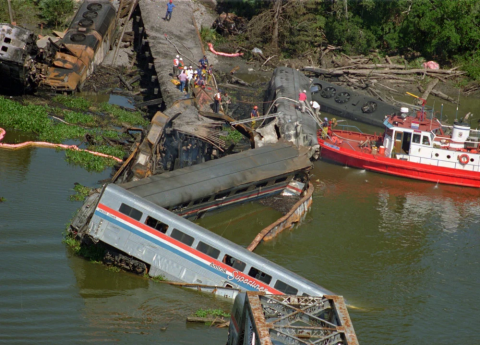
The image above is the Amtrak Sunset Limited, Train No. 2, at Big Bayou Canot, Alabama, on September 22, 1993. A barge had struck the CSX railroad bridge over the bayou, displacing the tracks by several feet. The train — carrying 220 passengers and crew — hit the misalignment at speed, derailed, and plunged into the water. Forty-seven people died. It was the deadliest accident in Amtrak's history.
The cause was not a failure of the locomotive. The engine was powerful. The schedule was on time. The crew was competent. The cause was that the bridge — the foundational infrastructure on which the entire system depended — had been silently compromised, and no monitoring system existed to detect the displacement before the train arrived.
This is the state of the global capital markets on Alamo Day, March 6, 2026. The locomotive (corporate earnings, GDP, employment) looks functional. The schedule (Fed rate path, CPI trajectory, consensus forecasts) appears on time. But the bridge — the foundational infrastructure of market-making, clearing, settlement, and price discovery — has been silently displaced by forces that the monitoring systems (VaR models, stress tests, aggregate-only regulatory reports) were not designed to detect:
- The COMEX silver delivery bridge has been displaced by 52.63 million ounces of March delivery notices against 86 million ounces of registered inventory — and declining.
- The LBMA clearing bridge has been displaced by a gross notional exposure of unallocated silver claims that is unreported, unaudited, and structurally invisible.
- The private credit bridge has been displaced by $3.8 billion in BCRED redemptions, Blue Owl gating, and a secondary market at $240 billion record volume.
- The bond market bridge has been displaced by a MOVE Index at a five-year breakout, signalling that the "risk-free rate" is no longer stable.
- The geopolitical bridge has been displaced by Operation Epic Fury, a Hormuz Strait closure enforced through insurance pricing, and a European energy supply chain operating at zero margin.
The train is on the bridge. The bridge has moved. The monitoring system has not detected it.
I wrote about this in January under the working title "The Train Is Leaving the Rails," warning of recession or depression risk driven by silver market fractures, excessive margin debt, and regulatory compliance failures, targeting a 12 to 24 month horizon. We are now, by my reckoning, approximately four months into that timeline. The derailment has not yet occurred. But the rails have shifted. And every data point this week — the MOVE breakout, the bullion rumours, the private credit gating, the pre-NFP equity positioning — is the vibration you feel through the floor of the carriage before the wheels leave the track.
Friedrich Hayek called it "the pretence of knowledge" — the belief that centrally gathered statistics can capture the dispersed, tacit, and constantly shifting information embedded in millions of individual transactions. The Federal Reserve's models are built on this pretence. The CFTC's Bank Participation Report is built on it. The LBMA's entire clearing architecture is built on it. The bridge at Big Bayou Canot was not monitored because nobody thought a barge could displace the rails. The LBMA's unallocated silver claims are not monitored because nobody at the regulatory level has acknowledged that a run on those claims is possible. The pretence of knowledge is the invisible barge that displaces the bridge.
Today is also Alamo Day. One hundred and ninety years ago, the line was drawn and the mission fell. The defenders — William Barret Travis, who drew the legendary line in the sand; James Bowie, who fought from his sickbed until overwhelmed; David Crockett, the former congressman who died fighting rather than surrendering — held for thirteen days against Santa Anna's army of thousands. They lost the battle. Six weeks later, at San Jacinto, Sam Houston's forces won the war in eighteen minutes, shouting "Remember the Alamo!"
It is also Middle Name Pride Day. My middle name is Alar — shared with my father, Alar Toomre, Professor Emeritus of Applied Mathematics at MIT and MacArthur Fellow. The name derives from the Estonian for "awakening." My father spent his career studying galactic collisions — the mathematics of what happens when two massive systems interact and the resulting structure is nothing either system could have predicted from its own internal dynamics alone. The parallel to the current market collision — precious metals delivery stress colliding with bond market volatility colliding with private credit illiquidity colliding with geopolitical disruption — is not metaphorical. It is the same mathematics applied to different substrates.
And it is Speech and Debate Education Day, which reminds us that the most powerful weapon in any market is not capital but the ability to articulate a thesis with precision and defend it against challenge. The Daily Coffee is, at its core, a speech and debate exercise conducted at the Kitchen Table every morning.
Remember the Alamo. Remember the Sampo. Remember the bridge at Big Bayou Canot.
II. Fever Dreams and NFP Day
I am writing this at 101.4°F, down from 102.2°F on Thursday. The flu is yielding — slowly — to Advil, fluids, and the discipline of the Kitchen Table. Last night's fever dream was vivid and specific: a capital markets crash led by a silver price spike to $150, followed by a cascade of bullion bank margin calls, followed by a COMEX cash-settlement announcement under Rule 701, followed by a 15% S&P 500 decline in three trading sessions. I woke at 4:30 AM and checked Globex. Gold was at $5,412. Silver at $84.50. The S&P 500 futures were down 1.85%. The fever dream had not yet arrived. But the bridge is shifting.
At 8:30 ET this morning, the Bureau of Labor Statistics releases the February 2026 Employment Situation report. This is the report that the January benchmark revision rendered almost meaningless — that 911,000-job downward revision, the largest in BLS history, means that any February print is being measured against a baseline that was itself fiction for twelve months. The "low-hire, low-fire" regime that characterised 2025 is ending. What replaces it is the question. The Tau Intelligence Engine assigns 65% probability to outright contraction rather than reacceleration.
My bias is toward the downside in equities regardless of the print.
The scenario matrix:
NFP OutcomeProbabilityEquity ResponseGold ResponseMOVE Response
Strong (>150K)25%Sell after 15-min head-fake rally (stagflation)Pause, then resume ascentSpike higher
Weak (<80K)30%Immediate hard selloff (recession)Spike toward $5,500Spike on rate-cut repricing
In-line (100–120K)45%Brief rally, then rollover (complacency trap)Grind higherSustain breakout
The context: the 2025 annual benchmark revision reduced total nonfarm employment by 911,000 jobs — the largest downward revision in BLS history. Average monthly job gains for 2025: 15,000. Not 49,000 as previously reported. Fifteen thousand. Federal government employment down 327,000 (10.9%) since peak. The "low-hire, low-fire" regime is ending. The Tau Intelligence Engine assigns 65% probability that its replacement is outright contraction.
III. The Silver Short, the Three Rumours, and the 17 Banks
The question remains: which 17 banks hold 215 million ounces of net short silver exposure on COMEX?
Rumour Mill — March 6, 2026
Disclaimer: The following rumours are unverified. BRC FinTech assigns Bayesian prior probabilities based on observable market signals and structural plausibility. These are not statements of fact.
RumourDescriptionPrior ProbabilityObservable Evidence
LBMA SuspensionMajor London clearer "informally" suspending physical silver delivery25%Physical premiums widening in London; Shanghai premium persistent at $8–13/oz
Sovereign RepatriationG7 central bank (prob. Bundesbank) seeking 500t gold repatriation15%Historical precedent (2013–2017 repatriation); "monetary reset" language in diplomatic channels
COMEX Cash-SettlementCME preparing Rule 701 emergency cash-settlement-only for March silver20%CME has authority; "technical issues" pattern (Nov 2025, Feb 2026); registered inventory insufficient
The rumour velocity itself is a data point. When physical premiums diverge from paper prices, and rumours circulate at sufficient intensity to move those premiums, the market is expressing a loss of trust in the paper-pricing infrastructure. The LBMA Silver Price is set by an opaque auction for a synthetic instrument. India has already delinked from it. Shanghai trades at a persistent premium above it. The structural bifurcation of global precious metals price discovery is underway — and it is not a rumour.
CME Incident Log (cumulative):
DateEventContext
Nov 27–28, 202510-hour Globex outage ("cooling failure")December First Notice Day
Feb 25, 202690-minute Globex halt ("technical issues")48 hours before March First Notice Day
OngoingMargin hikes: silver 11%→15%, gold 6%→8%Coincident with delivery stress periods
IV. Europe's Energy Vulnerability and the Alamo Supply Line
European natural gas storage: 46 bcm (down from 60 bcm last year). If Hormuz remains uninsurable, European natural gas prices return to EUR 100+/MWh — the 2022 crisis level. German manufacturing margins turn negative above EUR 40/MWh. The arithmetic for German steel production: at current energy costs of approximately EUR 65/MWh, a tonne of steel produced in Duisburg costs EUR 35–50 more than the same tonne produced in Turkey or India. At EUR 100/MWh, the differential widens to EUR 70–100. German steel becomes globally uncompetitive. The automotive supply chain — BMW, Mercedes, Volkswagen — depends on that steel. The downstream effect on European bank loan books is a credit event in slow motion.
The Alamo logistics parallel: Santa Anna stretched supply lines 1,200 miles from Mexico City to San Antonio. He prevailed at the Alamo through numerical superiority — 1,800 troops against fewer than 200 defenders — then lost the war six weeks later when those supply lines proved unsustainable at San Jacinto. Today, Operation Epic Fury spans 6,000+ miles from Norfolk to the Arabian Sea. Carrier strike groups consume approximately 100,000 gallons of fuel per day. The logistical nodes — Diego Garcia (sovereignty contested under the Chagos deal), Akrotiri (drone-struck by Iran), Al Udeid (within Iranian missile range) — are themselves under threat. The Ras Tanura shutdown removed the world's largest refinery complex from operation. The parallel between 1836 and 2026 is not one of technology but of geometry: the supply line has been extended past the point where it can be sustained against a determined adversary operating on interior lines.
For European banks in the GROUP-17 — Deutsche Bank, Commerzbank, BNP Paribas, Société Générale — the energy crisis compounds the precious metals stress through their corporate loan books. The Zombie Bank Monitor (Methodology Paper 2026-M003) identifies this multi-vector exposure as Characteristic 4: correlation risk that no single-factor VaR model captures. Extend-and-pretend on energy-sector loans — rolling facilities rather than enforcing covenants on borrowers whose margins have turned negative — is already Dimension 2 indicator activity.
Zombie Bank Monitor — GROUP-17 Tier 1 Preliminary Assessment:
InstitutionDim 1 (Market)Dim 4 (PM)Dim 6 (Revenue)Dim 7 (Sovereign)Classification
HSBCAmberRed (LPMCL)GreenAmberStressed
UBSGreenRed (LPMCL)GreenAmberStressed
Deutsche BankRedAmberRedRedZombie
CommerzbankRedAmberRedRedZombie
Société GénéraleAmber-RedAmberAmber-RedAmberBoundary
BNP ParibasAmberAmberAmberAmberStressed
Full methodology: BRCFinTech.com/research/2026-M003
V. The MOVE Index: Five-Year Breakout and What It Means
MOVE at 122.4. Five-year breakout confirmed. This is the single most important chart in capital markets this morning, and most equity investors have never heard of it.
The MOVE Index measures implied volatility in US Treasury options across the maturity spectrum. It is the VIX for the bond market. When the MOVE spikes, professional bond traders are pricing in large, uncertain moves in yields. When professional bond traders are uncertain, equity investors should be terrified — because the bond market is the dog and the equity market is the tail.
The transmission mechanism in five steps:
Step 1: MOVE rises → Treasury options price larger expected moves.
Step 2: Hedging costs increase → Portfolio managers required to maintain hedges (pension funds, insurance companies, bank ALM desks) must either pay the higher cost or reduce duration.
Step 3: Forced selling → Yields rise. The 10-year at 4.42% is up 30+ bps from its February low.
Step 4: Higher yields → Higher discount rates for all future cash flows. The present value of equities declines — particularly long-duration growth stocks whose valuations depend on earnings years in the future.
Step 5: Equities reprice. The Nasdaq is a leveraged bet on low bond volatility. When the MOVE breaks out, the Nasdaq breaks down. Arithmetic, not opinion.
The historical record:
- October 2023: MOVE peaked above 160. The 10Y yield touched 5%. The S&P 500 sold off 10%.
- March 2023: MOVE spiked above 180. SVB, Signature Bank, First Republic — the regional banking crisis.
- March 2020: MOVE hit 160+. COVID crash — S&P 500 down 34% from peak.
The current trajectory suggests we are in the early stages of a MOVE-driven equity repricing. The logical target for the S&P 500 is 5,200–5,300 (its 200-day moving average) over the next two to four weeks. Bond volatility leads equity volatility by approximately 15 trading days. The clock started this week.
Bond Vigilante Watch — March 6, 2026:
IndicatorLevelSignal
MOVE Index122.4FIVE-YEAR BREAKOUT
10Y UST Yield4.42%Rising on inflation repricing
2s/10s Spread+14 bpsSteepening — stagflation pricing
30Y Auction (Mar 12)UpcomingCritical: watch for tail
VI. The Rothschild-Ruemmler Pivot
Federal exhibit citations: EFTA00584904 ($25M contract); EFTA02592865 (Epstein to Rothschild: "kathy will decline attny general job today"); EFTA00582812 (Ruemmler retention on Latham letterhead); EFTA00669908 (settlement breakdown). Goldman Sachs confirmed Ruemmler's departure February 13, 2026.
The architecture of impunity. The opacity architecture. Same structure. Same beneficiaries.
Coming Monday: What were Jeffrey Epstein and Bill Gates building together — before COVID? The donor-advised fund. The bio-digital infrastructure. The Gates Foundation calendar entries. Sayer Ji opened the door. Monday's Coffee walks through it. No more teasing.
VII. Oil to CPI: The Transmission Timeline
PathwayLagCPI WindowEst. Impact
Gasoline30–45 daysApril CPI (May 13)+15–25 bps headline
Heating oil / electricity60–90 daysMay–June CPI+5–10 bps headline
Jet fuel → airfares45–75 daysApril–May CPI+3–5 bps core services
Diesel → trucking → food90–120 daysJune–July CPI+8–15 bps food at home
Second-round → wages, rent120–180 daysJuly–September CPI+5–10 bps core
Total cascade: ~40–65 bps additional headline CPI by Q3 2026.
These lag estimates are validated against the two most recent oil shocks. In the 2022 Russia-Ukraine supply disruption, gasoline prices responded within 35 days of the Brent spike, and food-at-home CPI reflected diesel pass-through within approximately 100 days — both within the ranges specified above. In the 2020 COVID demand collapse, the reverse transmission (falling oil → falling CPI) operated on nearly identical timescales. The model is not theoretical; it is historically calibrated.
The stagflation trap: if April CPI prints at 4.0%+ headline (up from the current 3.2% trajectory), the 95.6% probability of a March Fed hold becomes a certainty of extended holds through the summer. Rate-cut expectations for H2 2026 evaporate. The term premium on long-dated Treasuries rises further. The MOVE stays elevated. And gold — priced in a world where the real interest rate is falling even as the nominal rate holds steady — reprices toward $5,600 and beyond. Gold is the only major asset class that has historically delivered positive real returns in stagflation.
VII-B. The Ratepayer Protection Pledge: Will Big Tech Pay?
President Trump's Ratepayer Protection Pledge — secured from the Magnificent Seven (minus Anthropic: Apple, Amazon, Google, Meta, Microsoft, Nvidia, Tesla) — purportedly prevents AI data centre buildouts from spiking residential electricity bills.
The market's scepticism is warranted. Building 50+ gigawatts of AI data centre capacity with associated transmission, backup generation, and cooling requires an estimated $400–500 billion over five years. The specific legislative vehicles through which Big Tech will seek tax relief are already identifiable: the Infrastructure Investment and Jobs Act energy provisions, the Inflation Reduction Act clean energy credits, and pending state-level data centre incentive programmes in Virginia (which hosts approximately 70% of global internet traffic through Ashburn-area data centres), Texas (where grid capacity is already stressed), and Ohio (where Intel and other chip fabricators are simultaneously drawing grid capacity).
My assessment: the Pledge is a political instrument, not a binding financial commitment. Within 18 months, we will see the first applications for rate-base treatment of "shared infrastructure" that happens to serve both residential customers and data centres. The cost will be socialised. The inflation impact will arrive in the PPI approximately 12–18 months after the capital commitments are made — late 2027 or early 2028, layered on top of whatever energy-cost inflation the Iran conflict has already embedded.
The deeper question: the Magnificent Seven collectively spent over $200 billion on CapEx in 2025. The incremental grid compliance cost is $80–120 billion. When the choice comes down to shareholder returns and rate-base socialisation, American corporate history provides the answer. The Pledge will be honoured in the press release, diluted in the regulatory filing, and forgotten in the quarterly earnings call.
VII-C. Regulatory Calendar Through March 18
DateEventSignificance
Mar 6 (Today)February Employment Situation (NFP)Recession vs. stagflation signal
Mar 11February CPIFirst Iran energy-effect capture
Mar 1230-Year Treasury AuctionWatch for tail — bond stress indicator
Mar 13Q4 2025 GDP (2nd est.); UMich 5Y inflation expectations; JOLTSGrowth + inflation expectations combo
Mar 18February PPI; Fed rate decision + statementStatement language is everything
OngoingCOMEX March silver delivery cyclePeak delivery stress through month-end
Apr 1Russia Telegram ban effective dateDigital sovereignty milestone
VIII. Private Credit: The Regulators Are Not Listening
The contagion chain: Pension fund requests BCRED redemption → BCRED gates at 7% → Pension fund sells on secondary market at NAV discount → Discount becomes data point → Other investors question NAV → More redemption requests → Spiral deepens.
Now layer on the simultaneous stress vectors. The March COMEX delivery cycle is absorbing market-maker attention and capital. The Iran oil shock is repricing energy-sector credits that sit on these funds' loan books. The MOVE breakout is forcing portfolio-wide deleveraging. Each vector feeds into private credit because the same institutions — the GSIBs, the bulge-bracket brokers, the universal banks — are the market-makers, the leverage providers, and the counterparties across all of these markets simultaneously. The correlation is not a model assumption; it is an institutional fact.
UBS estimates that in an aggressive AI disruption scenario, US private credit default rates could climb to 13% — more than three times projected high-yield bond default rates. When 26% of BCRED's book is software exposure, AI disruption and delivery stress are not independent risks; they are the same risk wearing different masks. The enterprise SaaS companies that private credit loved to lend against — sticky recurring revenue, high margins, predictable cash flows — are discovering that every one of those characteristics is being stress-tested by AI substitution simultaneously.
The SEC, Fed, and OCC have not publicly acknowledged the stress. No cross-agency review. No stress-test publication for semi-liquid fund structures. A SPARQL query asking "show me all semi-liquid credit funds with redemption requests exceeding their quarterly cap, cross-referenced with the bank holding companies providing their leverage facilities" should be trivially answerable under a functioning FDTA implementation. Today, it is unanswerable. The opacity architecture extends from precious metals to private credit — a single structural deficiency replicated across every domain where transparency would threaten incumbent profits.
This is, as Brandeis wrote in 1914, a problem that sunlight would solve. The sunlight is the FDTA. The disinfectant is machine-readable, LEI-based, cross-venue reporting. The bankers' resistance to it is the same resistance they have always mounted against transparency — because opacity is the medium in which their profits swim.
Cheese Doodle Index — March 6, 2026:
FundCDI RatingStatus
Blackstone BCRED🧀🧀🧀🧀Gating 7.9%; employee backstop
Blue Owl OBDC II🧀🧀🧀🧀🧀Fully gated
Apollo Credit Opp.🧀🧀🧀Elevated redemptions
Ares Real Estate🧀🧀🧀🧀CRE marks under extreme pressure
KKR Private Credit🧀🧀🧀Rumoured elevated queue
Tau Intelligence Engine: 40% probability of a second major fund gating within two weeks. If it happens, Sampo Score moves to Critical (86+).
IX. The VCSB Rejection: A Formal Debate Proposition
In honour of Speech and Debate Education Day, the proposition:
Resolved: That the Object Management Group should be disqualified as a Voluntary Consensus Standards Body under OMB Circular A-119 for purposes of FDTA Section 5821 implementation.
Affirmative: The OMG is a 501(c)(6) trade association. Its membership dues come from technology vendors who profit from OMG-controlled standards. The conflict of interest is structural and irresolvable under the A-119 "balance of interest" criterion. The SBRM — developed in the open, MIT-licensed, built on W3C-standard RDF/OWL/SHACL — is the genuine alternative.
Negative: The OMG has decades of standards development experience, a proven process, and broad industry participation.
Rebuttal: Experience in a captured process does not cure the capture. Broad industry participation by vendors who profit from the standard is not balance; it is concentration. The FDTA was enacted to prevent this outcome. The Sampo must be forged in the open.
X. The Sampo Score, the Alamo Roll Call, and What Comes Next
The fever is 101.4°F. Down from 102.2°F on Thursday. The flu is yielding to Advil, fluids, and the curative properties of writing before dawn. But the dreams are not yielding. The silver spike. The margin calls. The train leaving the rails. The Sunset Limited plunging into the bayou. When the fever breaks, the dreams usually stop. When the market fever breaks — when the MOVE Index subsides, when the COMEX delivery cycle passes, when the private credit gates reopen — the structural fragilities that produced the crisis will remain, exactly as the displaced bridge at Big Bayou Canot remained displaced after the train had already fallen.
Periksiantamattomuus. The categorical Finnish refusal to surrender.
Periksiantamattomuus Index — Week of March 2–6, 2026:
DayRatingEvent
Monday (Mar 2)SisuIran strikes begin; gold spikes to $5,417
Tuesday (Mar 3)Sisu+Silver crashes 10.82%; gold drops 5.16%; Blood Moon
Wednesday (Mar 4)Dead cat bounceNo sisu required; the cat has no pulse
Thursday (Mar 5)Sisu returningMOVE breakout confirmed; flu at 102.2°F
Friday (Mar 6)PeriksiantamattomuusAlamo Day; NFP; three bullion rumours; fever dreams of derailment
Sampo Score — Weekly Trajectory:
DayScoreDriver
Monday (Mar 2)78Pre-Iran escalation baseline
Tuesday (Mar 3)80Gold/silver crash; dollar squeeze
Wednesday (Mar 4)79Dead cat bounce; temporary relief
Thursday (Mar 5)82MOVE breakout; private credit gating
Friday (Mar 6)84MOVE sustained; rumour velocity; NFP uncertainty
Today's Sampo Score: 84/100 (Severe Fragility — approaching Critical).
If the NFP triggers an equity selloff exceeding 2% today, the Sampo Score will likely reach 86 by Monday — entering the Critical Fragility band for the first time since the Tau Intelligence Engine began publishing composite scores. This is the threshold at which the individual fragility vectors cease to be independent risks and begin to compound through shared counterparties, shared margin mechanisms, and shared regulatory blind spots. It is the threshold at which the bridge displacement becomes visible — but only after the train has begun to cross.
Tau Intelligence Engine fragility indices:
- Energy Supply Chain: CRITICAL. Hormuz closure de facto. European gas storage declining. Ras Tanura offline.
- Precious Metals Delivery: SEVERE. Three rumours circulating. COMEX March delivery at peak stress. CME incident pattern documented.
- Private Credit Liquidity: SEVERE. BCRED gating. Blue Owl gating. Regulators silent.
- Bond Market Stress: CRITICAL. MOVE five-year breakout. 10Y rising. Stock-bond correlation positive.
- Digital Infrastructure Sovereignty: ELEVATED. Russia Telegram ban April 1. India LBMA delinking. Shanghai premium persistent.
The Alamo Roll Call
William Barret Travis — 26 years old, commander of the garrison. Drew the legendary line in the sand and asked his men to cross it if they would stay and fight. All but one crossed.
James Bowie — 40 years old, legendary frontiersman. Fought from his sickbed, too ill to stand, firing his pistols until overwhelmed.
David Crockett — 49 years old, former Tennessee congressman. Told his constituents, "You may all go to hell, and I will go to Texas." Died fighting at the barricade.
And 186 others whose names are inscribed in the Alamo cenotaph. Men who held the line knowing they would not survive. Men who understood that the purpose of holding the line is not to win the battle but to buy time for those who will win the war.
The parallel to the current market: the physical silver holders who refuse to sell into paper-price manipulation. The FDTA transparency advocates who challenge captured standards bodies in Washington conference rooms while the industry lobbyists outnumber them ten to one. The independent analysts who publish what the captured standards bodies will not — because Brandeis was right: sunlight is the best of disinfectants, and the bankers know it, which is why they fight so hard to keep the curtains drawn.
"Remember the Alamo" is not nostalgia. It is a statement of intent. The line holds. The Sampo will be forged in the open. The train may be approaching the displaced bridge — but we have documented the displacement, published the coordinates, and lit the signal fires.
Know your exits before you need them.
What Should the Reader Do? (Survival Hygiene)
First, respect the NFP. Bias: downside regardless of print. See Section II.
Second, gold at $5,412 is not expensive. Silver at $84.50 is a gift. Periksiantamattomuus.
Third, watch the MOVE. Five-year breakout. Bond vol leads equity vol by ~15 days. S&P target: 5,200–5,300.
Fourth, read Analytical Note 2026-007 and Zombie Bank Monitor 2026-M003.
Fifth, remember the bridge at Big Bayou Canot. The train was on time. The bridge had moved. The monitoring system did not detect it.
Sláinte. Remember the line.
Lars Toomre is Managing Partner of BRC FinTech Corporation and Brass Rat Capital LLC. BSME, MIT (1982). This represents personal commentary and analysis, not investment advice.